
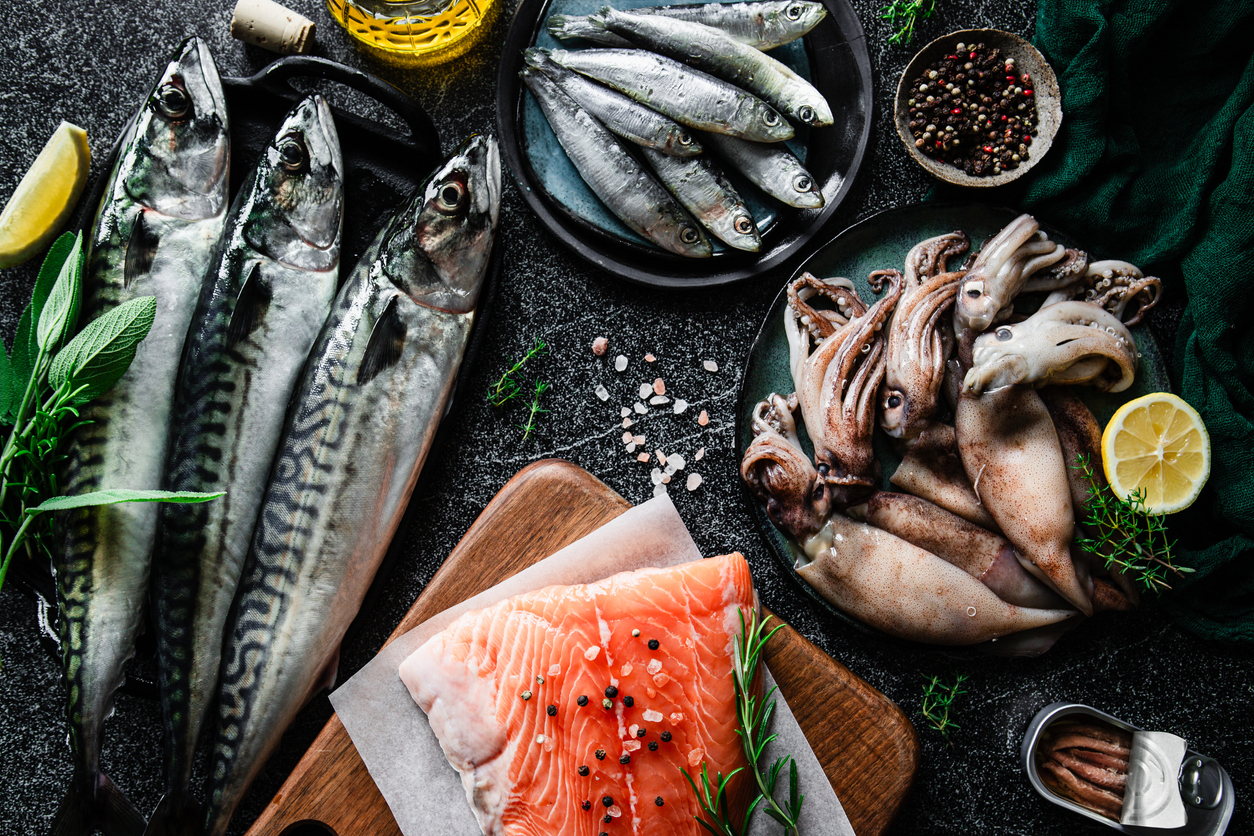
Australia has a deep-seated love for the ocean. From some of the world’s most beautiful beaches and coral reefs stem a love for surf, fishing, and of course, seafood. A Christmas table would not be complete without prawns, a fish-and-chips shop is never far away, and almost all restaurants have calamari on the menu. The famous Sydney Fish Market has crowned eight winners in the favourite seafoods contest. These are their best-performing products. So, are any sustainable seafoods on the list?
Anyone, anywhere, at any time, can find out if the seafood they are about to order or buy are endangered or otherwise unsustainable using the GoodFish Sustainable Seafood Guide, available as the Goodfish app on your phone. This guide celebrated its 20-year anniversary in 2024 and covers over 240 seafood options.
GoodFish rates wild and farmed seafood on this simple scale:
- BETTER CHOICE
This is the only rating where you will find wild species that are not currently overfished. Fish populations in this category have been historically stable in numbers and are caught or farmed using methods that have an acceptable environmental impact.
- EAT LESS
Wild-caught species in this category may be experiencing some stress from fishing practices. Bycatch of threatened species does not occur at a scale where populations cannot recover. Highly vulnerable ecosystems are not put at risk, but there could be damage to other habitats. Farmed fish with this rating may rely partially on wild fish for feeding. Negative impacts on wildlife (such as seals) and vulnerable species are managed through harm reduction strategies.
- SAY NO
This category covers wild-caught species impacted by overfishing or involve practices that produce significant bycatch of threatened or protected species. Farmed fish with this rating is raised in a way that is harmful to coastal and oceanic ecosystems.
1. Atlantic Salmon (Tasmanian Salmon)
SAY NO
Tasmanian salmon is a staple for many households, but it is far from a sustainable option. Atlantic salmon is not a native species to Australia. It is farmed in sea cages off the Tasmanian coast, with expanding operations to meet demand. Salmon farming has been particularly problematic in the Macquarie Harbour World Heritage Area where it poses an extinction risk to the Maugean Skate – an endangered species not found anywhere else.
This industry requires a large volume of wild-caught fish for feed. Efforts are being made to source this fish feed more sustainably, but more needs to happen in the industry to make this a more responsible option.
Salmon is one of my all-time favourite foods. It was something that I did not want to give up, but I no longer buy Tasmanian salmon or order it in restaurants. Enough tasty, more sustainable alternatives are available.
Atlantic salmon produced in Australia should not be confused with the native Australian salmon or farmed king salmon from New Zealand. Both are rated as better choices.
2. Prawns
| BETTER CHOICE | EAT LESS | SAY NO |
| Farmed Prawns in NSW, QLD | Banana Prawn, Endeavour Prawn, Western King Prawn, and Tiger Prawn in WA Western King Prawn, Banana Prawn, and Tiger Prawn in Commonwealth Waters | Endeavour Prawn, Western King Prawn, Eastern King Prawn, Bay Prawn, Banana Prawn, and Tiger Prawn in QLD Eastern King Prawn in NSW Farmed Prawn imported from Vietnam, Thailand, China, and Malaysia |
Prawns may be the hardest seafood to consume responsibly because of the sheer number of species and habitats affected by prawn fisheries. Most wild prawns are mostly caught using bottom otter trawls, a cone-shaped net with heavy ‘otterboards’ that drags and scrapes along the seafloor. This can destroy sensitive habitats like deep-sea coral reefs and seagrass beds. Muddy and sandy habitats are impacted to a lesser extent. These methods also produce large numbers of bycatch of threatened or endangered ray or shark species.
Farmed Australian prawns are our only better choice. These prawns are produced in land-based tanks and ponds. This industry consists of mostly small, well-managed and well-regulated operations. Improvements and innovations in prawn feeds mean that farmed Australian prawns produce more weight in food for us than the weight of wild fish they are fed from our oceans.
3. Oysters
BETTER CHOICE
You can sip on oysters with a clean conscience whenever you are in the mood for this delicacy. This is a reliable sustainable seafood. Oyster farms have a low impact on the environment and can even be carbon neutral. Oysters improve water quality as they feed by filtering the water – which also means that they require no fish feed, wild-caught or otherwise. Both native and invasive oyster species are farmed in New South Wales, Western Australia, South Australia, Tasmania and the Northern Territory. The spread of non-native species is well managed. Luckily, I love the taste of oysters!
4. Barramundi
BETTER CHOICE – Farmed in NSW, VIC, QLD, WA, SA, NT
EAT LESS – Wild Caught in WA
SAY NO – Wild Caught in QLD, NT
Sustainable farmed barramundi is available to most of us. Farming practices produce a low amount of wastewater, with some farms recycling all their water. Wild fish feeding inputs for barramundi farms roughly equal the amount of fish produced, so farms do not remove more wild fish than the volume of food they create.
Wild caught barramundi are generally caught using commercial gillnets, which indiscriminately trap anything that comes in its way and create a lot of bycatch. In Queensland and the Northern Territory, this bycatch includes threatened species like turtles, dolphins, dugongs, sharks, and sawfish. Out of environmental considerations, Queensland has committed to phasing out gillnets in parts of the Great Barrier Reef and the Gulf of Carpentaria by 2027. The Northern Territory has committed to a state-wide phaseout by 2028.
5. Mullet
BETTER CHOICE – Sea Mullet in WA
EAT LESS – Sea Mullet in NSW, QLD, Yelloweye Mullet SA
Sea mullet is a wild-caught fish that is found in sandy, sea grass, and mangrove habitats. Most sea mullet is caught using methods other than gillnets that greatly reduce the impact on threatened species and marine habitats. Western Australia has the healthiest stock of sea mullet in the country.
Yelloweye mullet has a precautionary EAT LESS rating. South Australia has the largest yelloweye mullet fishing operations and there is a concern that the industry is catching black bream as bycatch in the Lakes and Coorong area, a species that is overfished. GoodFish will apply this rating until this issue is resolved or disproven. Yelloweye mullet have a healthy population size and are resilient to fishing pressures.
6. Flathead
BETTER CHOICE Rock Flathead in VIC, Dusky Flathead in QLD
EAT LESS Deepwater Flathead in Commonwealth Waters, Dusky Flathead in NSW, QLD
SAY NO Tiger Flathead in Commonwealth Waters
Victoria’s rock flathead fishery is well managed since its code of practice was introduced in 2020. As for Queensland, GoodFish considers dusky flathead caught under the Moreton Bay Fresh label to be a BETTER CHOICE. This fishery operates under a code of practice that avoids harm to marine wildlife. Otherwise, dusky flathead is rated EAT LESS because it is caught using gillnets that catch and kill threatened species such as turtles, dugongs, sharks, and rays.
Deepwater flathead is fished using bottom trawling in the Commonwealth-managed Southern and Eastern Scalefish and Shark Fishery (SESSF) Great Australian Bight Trawl Sector. While deepwater flathead enjoy healthy populations, GoodFish is concerned about significantly shrinking catches recorded in an independent survey. Moreover, bottom trawling is notoriously indiscriminate. Approximately 40-60% of the total catch weight is unwanted and thrown overboard. The tiger flathead, caught in a different area of the SESSF, has a SAY NO rating. This fishery has a significant bycatch of species that are now listed as Threatened, Protected, or Endangered. GoodFish warns that this fishery needs major reform.
7. Tuna
EAT LESS Albacore Tuna in Eastern Australia, Yellowfin Tuna in Eastern Commonwealth Waters, Wild-caught Bigeye Tuna
SAY NO Albacore Tuna in WA, Yellowfin Tuna in Western Commonwealth Waters, Imported Albacore and Yellowfin Tuna, Farmed Southern Bluefin Tuna, Wildcaught Bigeye Tuna
Tuna are buckling under the pressure of our appetite. Albacore and yellowfin tuna populations are declining, but not yet at concerning levels along the eastern coast. Overfishing of these two species is occurring in the Indian Ocean population, leading to a SAY NO rating for tuna caught along the western coast and imported tuna.
The situation is similar for bigeye tuna. This fish is rated as EAT LESS if it was caught along the eastern coast but is over fished in the Indian Ocean and Western Australia.
Southern bluefin tuna is the only farmed species on the list. It is very popular for sushi and sashimi. Sea cages off the coast of South Australia grow wild-caught juveniles to a size big enough to sell, and these young fish are hungry. They consume much more wild fish from the ocean than the amount of bluefin tuna that ends up on our table.
8. Blue Swimmer Crab
BETTER CHOICE in WA, SA, QLD
EAT LESS in NSW, in WA & QLD depending on source
Blue swimmer crab can be sustainable seafood This species is caught in pots, which has minimal impact on habitat and produces little bycatch. South Australia stands out as having healthy blue swimmer crab populations that are well-managed. Western Australia has improved its management of this fishery, but here it is best to search for pot and net-caught crabs. If the crab is caught using bottom trawling, it is listed as EAT LESS.
In Queensland, blue swimmer crabs that carry the Marine Stewardship Council blue tick are your BETTER CHOICE. Otherwise, this species has an EAT LESS status because this fishery takes place in dugong, turtle, and speartooth shark habitat.
Shopping for Sustainable Seafood is Tricky, But Not Impossible
After writing this, I realised that shopping for sustainable seafood is not straightforward. It often depends on where the seafood comes from, and the particular species in question. The oceans are facing a crisis of overfishing that is taking far too long to be addressed. So the more consumers can do to avoid eating vulnerable species, the better.
If this list was a bit depressing for you, don’t despair. There are plenty of good options out there, including seafoods that you will regularly see on restaurant menus. The Goodfish app can also help you pick a restaurant or fish and chips shop that has pledged serve only sustainable seafood. The list is small for now, but I hope it will grow steadily and rapidly.